Home › System specifications
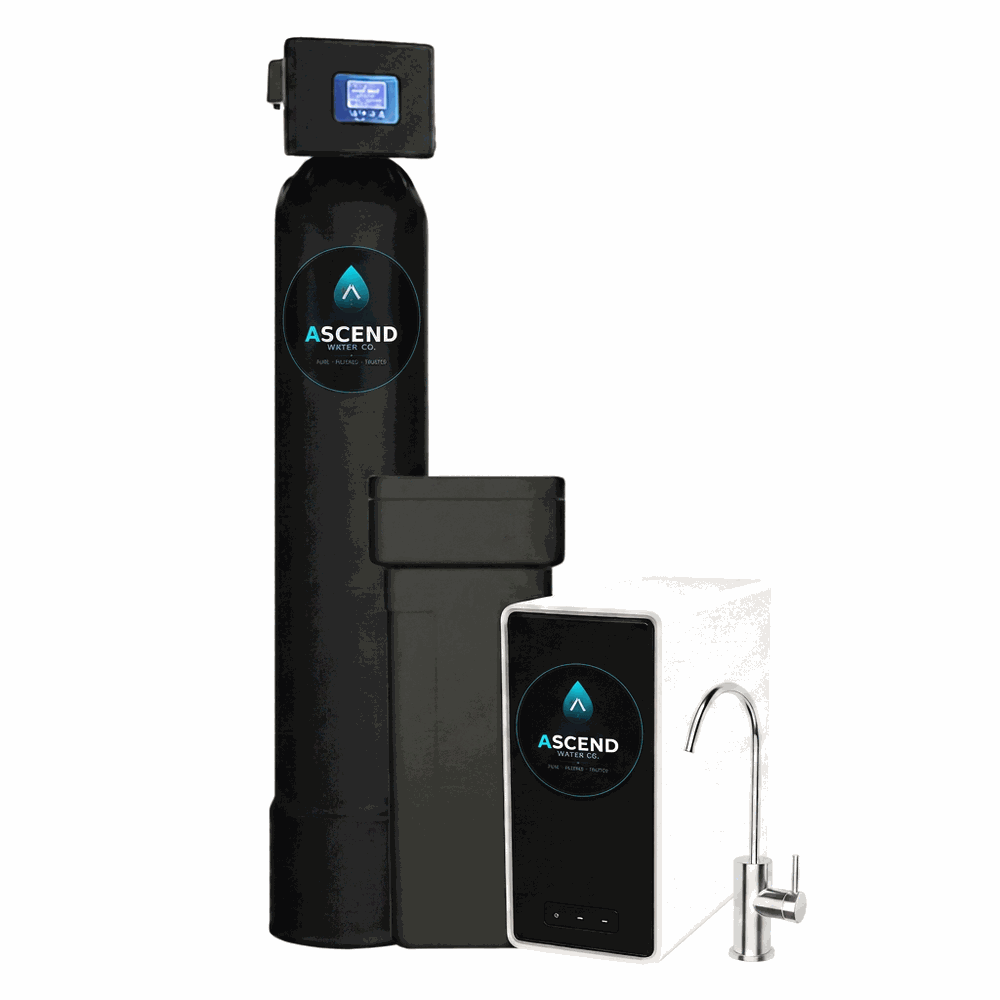
Complete Home Softener & Filtration System
The full specification, published. Print it, screenshot it, take it to whoever else you have quoting you. Resin volume, carbon volume and valve type are what actually separate systems — not brand names or a slideshow of contaminants.
At a glance
System data.
Media & controls
What is inside the tank.
- Ascend ProValve
- Ceramic discs for longer service life and reduced maintenance. Highly configurable with a straightforward programming interface, long-term memory for program settings and a 72-hour memory backup so a power outage does not wipe your configuration.
- USA-made high-capacity softening resin
- 10% crosslinked resin removes hardness and lasts longer than standard 8% resin. Better resistance to chlorine and oxidation, and it delivers high-flow soft water without a pressure drop.
- Granular activated coconut shell carbon
- Treats chlorine, chloramine and other contaminants. Sustainably sourced from a renewable material, and built for extended filtration capacity rather than a short service life.
- Polishing gravel underbed
- Supports the resin bed for optimal flow and efficiency, and prevents channeling so water passes evenly through the media instead of finding a path around it.
AW800 AlkaPro
Seven stages of drinking water treatment.
The tankless reverse osmosis system included with every Complete Home System, at the kitchen sink.
- Stage 1
- 5 micron polypropylene sediment pre-filter to capture suspended material before it reaches the membrane.
- Stages 2–3
- Two NSF carbon block filters targeting chloramine, THMs and TCE. The carbon block also prepares the water to enter the reverse osmosis element.
- Stage 4
- High-rejection NSF thin film composite reverse osmosis membrane, 800 GPD. Rejects a wide spectrum of impurities including total dissolved solids, heavy metals, microplastics and PFAS.
- Stage 5
- In-line NSF coconut shell granular activated carbon filter to remove dissolved gases, taste and odor from the product water.
- Stage 6
- Internal alkaline remineralizer. Adds calcium and magnesium back, balances pH and keeps the water from tasting flat.
- Stage 7
- Final in-line NSF coconut shell GAC polish before the water reaches your faucet.
Two builds
Single tank or dual tank.
The specification above describes the single-tank Complete Home System at $3,500 installed, where softening resin and carbon share one 15" x 52" vessel.
On the $4,000 dual-tank build, each media gets a tank of its own — a full resin bed and a full carbon bed. Same components, same warranty, same drinking water system. The gain is carbon contact time, which is what determines how much chloramine actually comes out.
typical hardness
Reported range 9–18 gpg · scale 0–20
- Coverage
- Greater Houston + 2 hrs
- Common source
- Gulf Coast Aquifer & treated surface water
- Common disinfectant
- Chloramine on converted supplies
- Typical range
- 9–18 gpg
- Classification
- Very hard
Nearly every city we serve tests in the hard or very hard band. Pick your city below for local detail, or book a free test at your tap.
Spec FAQ
Specification questions.
What does 10% crosslinked resin mean?
Crosslinking describes how tightly the resin beads are bonded. Standard softener resin is 8% crosslinked. At 10% the beads are denser and more resistant to chlorine and oxidation, which is what wears resin out. It costs more and lasts longer, which matters on Houston supplies carrying a disinfectant residual.
Why coconut shell carbon specifically?
Coconut shell carbon has a higher micropore volume than coal-based carbon, which is what does the work on chlorine and chloramine. It is also a renewable material rather than a mined one.
Is 48,000 grains enough for my home?
That depends on your measured hardness and how much water your household uses. At the 12 to 16 grains typical around Katy and Cypress it covers most three-to-four person homes comfortably. Larger or higher-use households are where we start recommending the dual-tank build. The free water test is what settles it.
Can I get this as a PDF?
Yes — the full specification sheet is available to download from this page. Print it and take it to whoever else you have quoting you. We would rather you compare than take our word for it.
Get started
Ready for water you can actually trust?
Tell us a bit about your home and we will send a no-pressure quote — usually within one business day. Or book the free in-home test: about 20 minutes at your kitchen sink, written results either way.
- Call or text(435) 881-7380
- Emailhello@ascendwaterco.com
- Visit25220 Kingsland Blvd Suite 100, Katy, TX 77494
- HoursMonday–Saturday, 8:00 AM – 7:00 PM